Global e‑invoicing compliance

Reduce invoice rejections across global e‑invoicing mandates and digital tax reporting requirements. Vertex Cloud connects tax determination, invoice validation, clearance, and regulatory reporting in one unified compliance platform.

Meet real-time e-invoicing and reporting mandates with Vertex Cloud

Enable compliant invoice submission across jurisdictions and meet global e-invoicing mandates, real-time reporting, and digital tax requirements. Vertex Cloud connects tax determination, invoice validation, clearance, and regulatory reporting in a unified platform to automate end‑to‑end compliance.

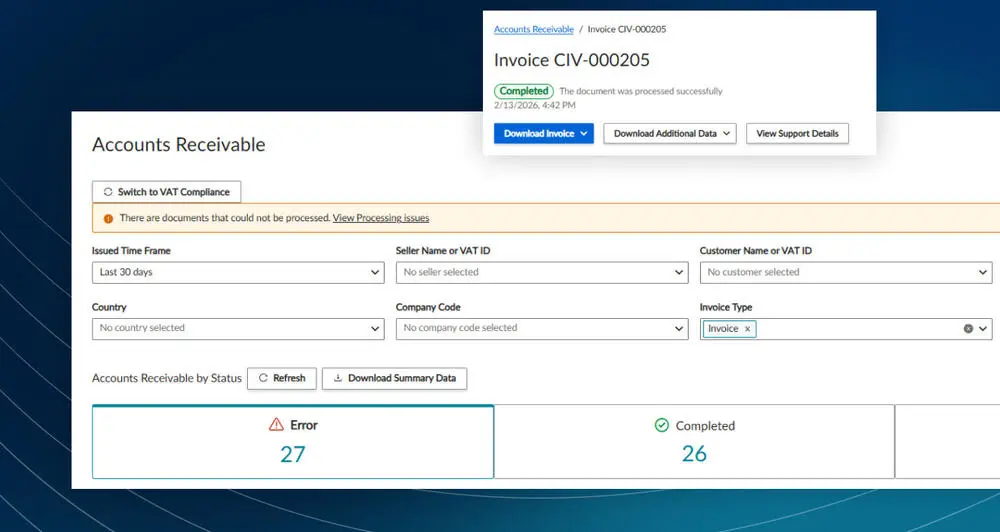
Vertex Product screenshot demonstrating Real-Time e-Invoicing Dashboard with excerpt for invoice status.

Direct global e-invoicing connectivity

Keep invoices moving without delay across global e‑invoicing and continuous transaction control (CTC) mandates by exchanging data with tax authorities using jurisdiction‑specific clearance and reporting formats.

Global CTC and Peppol coverage

Reduce invoice rejections and support compliance across global e‑invoicing, real‑time reporting, CTC frameworks, Peppol networks, and VAT mandates through automated, real‑time interoperability with tax authorities and connected systems.

Continuous compliance updates

Stay compliant with evolving global e‑invoicing, real‑time reporting, and VAT mandates with continuously updated regulatory logic applied across transactions.

Connected VAT and invoice compliance

Deliver compliant, accepted invoices across jurisdictions by synchronising global e‑invoicing, real‑time reporting, VAT compliance, and tax determination.

Single platform integration

Simplify global e‑invoicing compliance by managing CTC validation, clearance, real‑time reporting, and archiving within a centralised framework, with support for country‑specific mandates delivered through native and partner‑enabled capabilities.

Future-ready compliance infrastructure

Adapt to evolving global e‑invoicing, real‑time reporting, and CTC mandates with scalable clearance, reporting, and archiving to support continuous compliance as regulatory requirements change.

“Vertex’s professional and collaborative approach convinced us that they are the right partner for our e-invoicing transformation.”

Josef Wieser,
Manager Indirect Tax Technology, Brückner Group

Global e-invoicing country coverage

  • Austria Flag
  • Belgium Flag
  • Croatia Flag
  • France Flag
  • Germany Flag
  • Greece Flag
  • India Flag
  • Ireland Flag
  • Italy Flag
  • Malaysia Flag
  • Mexico Flag
  • Norway Flag
  • Poland Flag
  • Portugal Flag
  • Romania Flag
  • Saudi Arabia Flag
  • Spain Flag
  • Sweden Flag
  • Taiwan Flag
  • United Kingdom Flag

Automate end-to-end indirect tax reporting obligations

Track Continuous Transaction Controls (CTC) alongside Periodic Transaction Controls (PTC) and manage e-invoicing, e-reporting and regulatory returns via a single platform.

Enterprise-grade security and controls

Vertex meets the highest industry standards for data protection, regulatory compliance and enterprise governance supporting secure global tax operations at scale.

  • Peppol Access Point Certified Provider Logo
  • GS1 Solution Provider for Structured Data and E-Document Standards Logo
  • GENA Member Logo
  • Facturation électronique Logo
  • VeR Member Logo
  • ISO 27001 Logo

Frequently asked questions about global e-invoicing compliance

E-invoicing (short for ‘electronic invoicing’) is the digital process of creating, sending, receiving and processing invoices between businesses (B2B) or between businesses and government entities (B2G). This new electronic method replaces the traditional paper-based or digital invoicing system with a structured electronic format, opening the door to innovation with technology and automation.

E-invoicing is becoming increasingly popular worldwide due to its numerous advantages, including efficiency, accuracy, transparency and enhanced security. A growing number of governments are mandating or incentivising businesses to switch to electronic invoicing methods, both to promote digitalisation and combat tax evasion.

CTC involves the real-time monitoring and reporting of transactions, providing tax administrations with enhanced capabilities to combat VAT fraud and improve tax collection. This shift towards CTC has led to the implementation of e-invoicing, which enables businesses to exchange structured invoice data electronically and replaces traditional paper-based or digital invoices.

The introduction of e-invoicing mandates has reshaped VAT compliance by enforcing stricter reporting standards and requiring digital processes for real-time invoice validation and automated data submission to tax authorities.

Companies need to adapt their compliance strategies and potentially restructure existing processes to meet the demands of automation and increased tax audits.

Under e-invoicing mandates, the following types of transactions typically fall within the scope:

  • Business-to-Business (B2B) domestic transactions: These are transactions that occur between two businesses within the same country. E-invoicing mandates often require businesses to electronically exchange structured invoice data for B2B transactions.
  • Business-to-Business (B2B) inter-company transaction: These are transactions that occur within a corporate group. These transactions are affected by transfer pricing agreements and are subject to the same e-invoicing requirements as other B2B transactions. To date, this is required where domestic VAT groupings are not possible. In 2028, legislation is expected to address cross-border transactions and their subjectivity to e-invoicing.
  • Business-to-Government (B2G) domestic transactions: These are transactions between businesses and government entities within the same country. E-invoicing mandates typically require businesses to submit electronic invoices to government agencies for B2G transactions.
  • Business-to-Consumer (B2C) domestic transactions: These are less common than the other transaction types, but Tax Authorities have started to use them. B2C transactions, which involve sales to individual consumers, are typically not subject to e-invoicing requirements, subject to future regulatory changes.

  • Standard invoices: These are the most common type of e-invoice that businesses use to request payment from their customers.
  • Credit notes: E-invoicing can also be used for credit notes, which are issued when a refund or adjustment is required for a previously issued invoice.
  • Debit notes: Debit notes are issued when additional charges need to be applied to an existing invoice. E-invoicing can also be used for these types of invoices.
  • Proforma invoices: Proforma invoices are preliminary invoices that are issued before the actual goods or services are delivered. E-invoicing can be used to issue proforma invoices as well.
  • Electronic billing statements: Some businesses use e-invoicing to send electronic billing statements to their customers on a periodic basis, summarising all of the invoices and payments made during a specific time period.
  • Self-billing invoices: An agreement between the supplier and the customer where the customer is authorised to generate invoices on the supplier's behalf.

Compliance that’s continuous. Confidence that’s built in.

Put the power of Vertex to work for you.